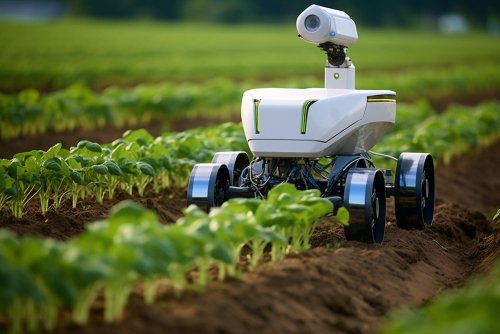
§ Agriculture
Decisions made in the field, not the data centre.
Crop vision on the implement, environmental sensing on solar power, and equipment health — all running without a connection.
§ Why edge AI
The case for running it on the asset.
Connectivity in a 200-hectare field is unreliable, expensive and slow, so the decision has to be made on the machine or at the sensor. E1M-AEN covers the battery and solar end: environmental logging from sub-1 mW standby, waking its NPU only on an event. E1M-X V2N adds a camera pipeline and DRP-AI3 for per-plant decisions on the implement; E1M-X V2N-M1 adds the DEEPX DX-M1 for higher-resolution or multi-camera vision. All three are rated from −40 °C.
§ The constraint
Field-deployed sensors can't phone home every minute on solar power. Tractors run faster than the cellular tower can stream. Crop-detection latency is measured in centimetres of travel.
Cloud round trip
sensor → uplink → inference → downlink → action
On-module
sensor → on-module inference → action
Sensor
Crop camera feed
On-module inference
E1M-X V2N
Action
Per-plant treatment decision
01 · Sense
A camera on the boom or implement; temperature, humidity and vibration sensors on nodes and machines.
02 · Infer
Crop / weed detection on DRP-AI3 (V2N); anomaly scores on the Ethos-U (AEN), woken on an event.
03 · Decide
Per-plant treatment, an excursion alarm, or a maintenance flag — made locally, offline.
04 · Sync
Results queue until a link exists; long-range radios such as LoRa or LTE-M go on the carrier board.
§ Where it fits
What teams build with it.
01
Spot spraying
Crop / weed detection on the implement, so the spray decision is made per plant at driving speed.
02
Field sensor nodes
Solar or battery AEN nodes that log the environment and wake the NPU only when a reading looks wrong.
03
Post-harvest cold chain
Temperature-excursion time and Mean Kinetic Temperature computed on the logger, not reconstructed later from a cloud export.
04
Equipment health
Bearing and drivetrain monitoring on tractors and pumps, before a failure strands the machine in the field.
§ Recommended modules
Pick the AI compute that fits.

E1M-AEN
Battery and solar field nodes, cold-chain loggers and equipment-health monitors.
- CPU
- 0 / 1 / 2× Arm Cortex-A32 @ 800 MHz (per SoC: E3/E4 none, E5/E6 single, E7/E8 dual)
- NPU
- 2× Arm Ethos-U55; E4/E6/E8 add 1× Arm Ethos-U85 (250 GOPS · E3/E5/E7, 454 GOPS · E4/E6/E8)
- Temp
- −40 °C to +75 °C
Full specs →

E1M-X V2N
A camera on the implement: per-plant decisions on DRP-AI3.
- CPU
- Quad Cortex-A55 @ 1.8 GHz
- NPU
- DRP-AI3 4 TOPS (dense), 15 TOPS (sparse)
- Temp
- −40 °C to +85 °C
Full specs →

E1M-X V2N-M1
Multi-camera or higher-resolution vision with the DX-M1.
- CPU
- Quad Cortex-A55 @ 1.8 GHz
- NPU
- DRP-AI3 4 TOPS + DeepX DX-M1 25 TOPS
- Temp
- −40 °C to +85 °C
Full specs →
§ Inside the E1M-X V2N
The module this vertical leads with.

- CPU
- Quad Cortex-A55 @ 1.8 GHz
- MCU (SoC)
- Cortex-M33 @ 200 MHz
- MCU (I/O)
- Cortex-M33 @ 216 MHz — standalone, not in the SoC
- NPU
- DRP-AI3 4 TOPS (dense), 15 TOPS (sparse)
- RAM
- up to 8 GB LPDDR4X
- ROM
- up to 16 GB eMMC
- MIPI CSI-2
- 2× 4-lane; up to 8 cameras via MIPI virtual channels (4 per port) with an aggregator / deserializer on the carrier
- MIPI DSI
- 1× (display out)
- Ethernet
- 2× 1 GbE
- USB
- USB 3.2 + USB 2.0
- PCIe
- Gen3 x2
- CAN-FD
- 2 channels
- Connectivity
- 2.4 / 5 / 6 GHz Wi-Fi (802.11 a/b/g/n/ac/ax, 143 Mbps) + Bluetooth 5.4 (BR/EDR/LE, 3 Mbps)
§ Reference examples from the Alp SDK
Code you can fork, with its evidence on the label.
Every example is real C/C++ in the open-source alp-sdk repo. Clone it, change the SKU in board.yaml, build. Each card says how far it has been proven (on silicon, partly, or not yet on hardware) as recorded in the example's own README and the SDK's verification ledger.
1 Partly on silicon · 4 Not yet on hardware
ai-object-detection-realtime
Not yet on hardwareCrop / weed detection
The portable YOLOv8-tiny detection skeleton — camera in, detections and FPS out — as the starting point for crop-row vs. weed classification.
E1M-V2M101 · Skeleton today: the checked-in M33 slice runs TFLM on the CPU. A DX-M1 run needs an A55/Yocto app, a compiled YOLOv8-tiny model and V2N-M1 hardware validation.
View on GitHub ↗
v2n-drpai-inference
Partly on siliconDRP-AI3 inference
Load a DRP-AI-compiled model and run still frames through the RZ/V2N on-die NPU via <alp/inference.h>, with per-image timing.
E1M-V2N101 · The DRP-AI backend has run on silicon (E1M-V2M103: YOLOX-S, about 40 ms per frame); this app itself has not yet been re-verified on hardware.
View on GitHub ↗
cold-chain-monitor
Not yet on hardwareCold-chain monitor
BME280 temperature / humidity / pressure logging with temperature-excursion time, Mean Kinetic Temperature and dewpoint, plus an AI anomaly score.
E1M-AEN801 · Runs end to end on native_sim; a run with a real BME280 and a trained model is bench-gated.
View on GitHub ↗
ai-anomaly-detection-vibration
Not yet on hardwareEquipment health monitoring
Accelerometer → 1D-CNN → anomaly score on the Ethos-U NPU, for bearings and drivetrains on autonomous machines.
E1M-AEN801 · Compiles; not yet run on hardware.
View on GitHub ↗
iot-connected-camera
Not yet on hardwareConnected camera
Camera → DRP-AI3 classifier → local LVGL UI plus MQTT publish / subscribe. The reference shape of a smart camera on E1M-X V2N.
E1M-V2N101 · Staged reference app; the README status table lists what runs today and what is still a target.
View on GitHub ↗
Portable SDK headers for this vertical
These are the SDK's portable surfaces across E1M families; what each family supports underneath them is on the SDK page.
§ Getting started
From example to your board.
- 01First, scaffold a project from the reference example:
tan init --from-example v2n/v2n-drpai-inference - 02Then set
som.skuin board.yaml to your module (the example ships targetingE1M-V2N101). - 03Build with the
tanCLI or the Alp IDE extension for VS Code, and run it on an E1M EVK. - 04Before relying on a result, read the status block at the top of the example README — it says what has run on hardware and what has not.
§ Proven today, and what is ahead
On silicon today: the DRP-AI3 backend running a detector on RZ/V2N hardware (YOLOX-S, about 40 ms per frame). Still ahead: the agriculture-specific examples on hardware with trained models — they run end to end on native_sim now.
SDK verification ledger ↗§ Built for this vertical
Why E1M wins here.
- →
AEN: sub-1 mW standby, wake-on-event AI — suited to solar + battery nodes
- →
IP67-ready when paired with a sealed carrier board
- →
−40 °C to +75 °C on AEN, −40 °C to +85 °C on V2N and V2N-M1 — rated for sub-zero winters and hot summers
- →
Long-range radios (LoRa, LTE-M) are added on the carrier board, not the module