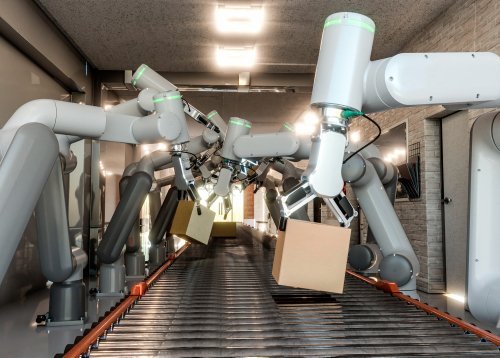
§ Industrial automation
Inspect the product. Watch the machine.
Visual inspection on the line and predictive maintenance on every motor — on-premises, with no cloud dependency.
§ Why edge AI
The case for running it on the asset.
Factory edge AI comes down to two jobs: watching the product and watching the machines. Visual inspection needs a camera pipeline and real NPU throughput — E1M-X V2N or V2N-M1, with Linux on the A55 cluster. Machine health needs always-on sensing on a small power budget — E1M-AEN, with sub-1 mW standby, waking its Ethos-U NPU when vibration, current or temperature looks wrong. Both run the same SDK, and both keep operational data on the premises.
§ The constraint
Operational data stays on-premises. SCADA/PLC integration is local. Down a network, the line keeps running. Industrial-temperature modules with at least 10-year availability — because re-spinning a control board costs more than the controller itself.
Cloud round trip
sensor → uplink → inference → downlink → action
On-module
sensor → on-module inference → action
Sensor
Vibration and camera feed
On-module inference
E1M-AEN
Action
Defect classification on the line
01 · Sense
A line camera for inspection; an accelerometer, INA236 current monitor and BME280 on the machine.
02 · Infer
Autoencoder defect maps on the camera path; feature windows and anomaly scores on the Ethos-U.
03 · Corroborate
Faults are confirmed across vibration, current and temperature before an alert is raised.
04 · Report
PASS/FAIL to the line controller and health flags to SCADA, on the premises network.
§ Where it fits
What teams build with it.
01
Surface inspection
Unsupervised defect detection trained only on good parts, so new defect types are caught without a labelled defect library.
02
Motor and pump health
Vibration, current and temperature fused on the always-on core, so a corroborated fault raises an alert and a lone blip does not.
03
Retrofit sensor nodes
Battery or line-powered AEN nodes bolted onto existing machines, waking the NPU on an event instead of streaming raw data.
04
PLC / SCADA integration
A Modbus register model selected with one board.yaml line, with signed boot and OTA declared in the same file as the application.
§ Recommended modules
Pick the AI compute that fits.

E1M-AEN
Machine-health nodes: vibration, current and temperature on the always-on core.
- CPU
- 0 / 1 / 2× Arm Cortex-A32 @ 800 MHz (per SoC: E3/E4 none, E5/E6 single, E7/E8 dual)
- NPU
- 2× Arm Ethos-U55; E4/E6/E8 add 1× Arm Ethos-U85 (250 GOPS · E3/E5/E7, 454 GOPS · E4/E6/E8)
- Temp
- −40 °C to +75 °C
Full specs →

E1M-X V2N
Line-side inspection on DRP-AI3 with a Linux camera pipeline.
- CPU
- Quad Cortex-A55 @ 1.8 GHz
- NPU
- DRP-AI3 4 TOPS (dense), 15 TOPS (sparse)
- Temp
- −40 °C to +85 °C
Full specs →

E1M-X V2N-M1
Higher-throughput inspection: 29 TOPS across two NPUs.
- CPU
- Quad Cortex-A55 @ 1.8 GHz
- NPU
- DRP-AI3 4 TOPS + DeepX DX-M1 25 TOPS
- Temp
- −40 °C to +85 °C
Full specs →
E1M-X V2H
8 TOPS dense DRP-AI3 plus Cortex-R8 cores. In development.
- CPU
- Quad Cortex-A55 + 2× Cortex-R8 @ 800 MHz
- NPU
- 8 TOPS dense / 80 TOPS sparse (DRP-AI3)
- Temp
- −40 °C to +85 °C
Learn more →
§ Inside the E1M-AEN
The module this vertical leads with.

- MCU (SoC)
- 2× Arm Cortex-M55: 1× 160 MHz (HE) + 1× 400 MHz (HP)
- CPU
- 0 / 1 / 2× Arm Cortex-A32 @ 800 MHz (per SoC: E3/E4 none, E5/E6 single, E7/E8 dual)
- NPU
- 2× Arm Ethos-U55; E4/E6/E8 add 1× Arm Ethos-U85 (250 GOPS · E3/E5/E7, 454 GOPS · E4/E6/E8)
- SoC family
- Alif Ensemble E3 / E4 / E5 / E6 / E7 / E8
- RAM
- 13.5 MB (E3/E5/E7) or 9.75 MB (E4/E6/E8) SRAM on-die
- ROM
- 5.5 MB MRAM on-chip
- External memory
- HyperRAM + NOR flash on one OSPI bus: E1M-AEN803 fits 512 Mbit HyperRAM + 256 Mbit NOR; E1M-AEN801 fits none; build option on E1M-AEN301 / 401 / 501 / 601 / 701
- MIPI CSI-2
- 1× 2-lane
- MIPI DSI
- 1× 2-lane
- Parallel Camera
- 1× (8-bit parallel)
- Ethernet
- 100 Mbps PHY
- USB
- USB 2.0 HS
- CAN-FD
- 1 channel (CAN PHY is an assembly option)
- Connectivity
- 2.4 GHz Wi-Fi 6 + BLE 5.4 (BDE-BW3501N, TI CC3501E)
§ Reference examples from the Alp SDK
Code you can fork, with its evidence on the label.
Every example is real C/C++ in the open-source alp-sdk repo. Clone it, change the SKU in board.yaml, build. Each card says how far it has been proven (on silicon, partly, or not yet on hardware) as recorded in the example's own README and the SDK's verification ledger.
4 Not yet on hardware · 2 Reference
visual-defect-detection
Not yet on hardwareVisual defect detection
Unsupervised surface inspection: an autoencoder learns the good surface, and tiles it reconstructs poorly are flagged — including defect types never seen in training. Per-frame PASS/FAIL with worst tile and coverage.
E1M-AEN801 · Runs end to end on native_sim with synthetic frames; a run with a real CSI camera and a trained model is bench-gated.
View on GitHub ↗
multimodal-fusion-pdm
Not yet on hardwareMulti-sensor motor health
Fuses vibration (ICM-42670), current (INA236) and temperature (BME280) into one fault hypothesis. A single-sensor blip is flagged as uncorroborated instead of raising a false alarm.
E1M-AEN801 · Runs end to end on native_sim; a run with the three real sensors and a trained model is bench-gated.
View on GitHub ↗
motor-current-signature
Not yet on hardwareMotor current signature
INA236 high-side current monitor → feature window → OFF / NORMAL / INRUSH / OVERLOAD / STALL state plus an anomaly score. The electrical side of predictive maintenance.
E1M-AEN801 · Scoped to DC rails and brushed-DC motors. Runs end to end on native_sim; a run on a real motor with a trained model is bench-gated.
View on GitHub ↗
ai-anomaly-detection-vibration
Not yet on hardwareVibration anomaly detection
Accelerometer → 1D-CNN → anomaly score on the Ethos-U NPU, running on the always-on side of the module.
E1M-AEN801 · Compiles; not yet run on hardware.
View on GitHub ↗
modbus-server
ReferenceModbus register model
Zephyr Modbus client and server selected with one libraries: [modbus] line in board.yaml — the starting point for PLC / SCADA integration.
E1M-V2N101 · Hardware-free teaching example: client and server in one process on native_sim (RAW_ADU), no UART, RS-485 or TCP stack.
View on GitHub ↗
production-deployment
ReferenceProduction deployment stance
Manufactured → deployed → updated → attested on one app: every declarative boot:, ota:, security.psa: and storage: block at the stance the SDK recommends for shipping product.
E1M-AEN801 · A configuration reference. A real-silicon run needs a staged Mender server, and OTA apply is deferred on E1M-AEN801 (#1069).
View on GitHub ↗
Portable SDK headers for this vertical
These are the SDK's portable surfaces across E1M families; what each family supports underneath them is on the SDK page.
§ Getting started
From example to your board.
- 01First, scaffold a project from the reference example:
tan init --from-example ai/multimodal-fusion-pdm - 02Then set
som.skuin board.yaml to your module (the example ships targetingE1M-AEN801). - 03Build with the
tanCLI or the Alp IDE extension for VS Code, and run it on an E1M EVK. - 04Before relying on a result, read the status block at the top of the example README — it says what has run on hardware and what has not.
§ Proven today, and what is ahead
The industrial examples run end to end on native_sim with synthetic data today; runs with real sensors and trained models are bench-gated. On silicon already: Ethos-U85 inference on E8 (person_detect, all operators on the NPU) and energy per inference measured on the EVK — the building blocks these monitors sit on.
SDK verification ledger ↗§ Built for this vertical
Why E1M wins here.
- →
−40 °C to +75 °C on AEN, −40 °C to +85 °C on V2N and V2N-M1
- →
At least 10 years of production availability from volume-production start, subject to silicon supply (LCS-E1M-001)
- →
OPTIGA Trust M secure element on E1M-X V2N / V2N-M1; MCUboot secure boot (signed images only) on E1M-AEN